
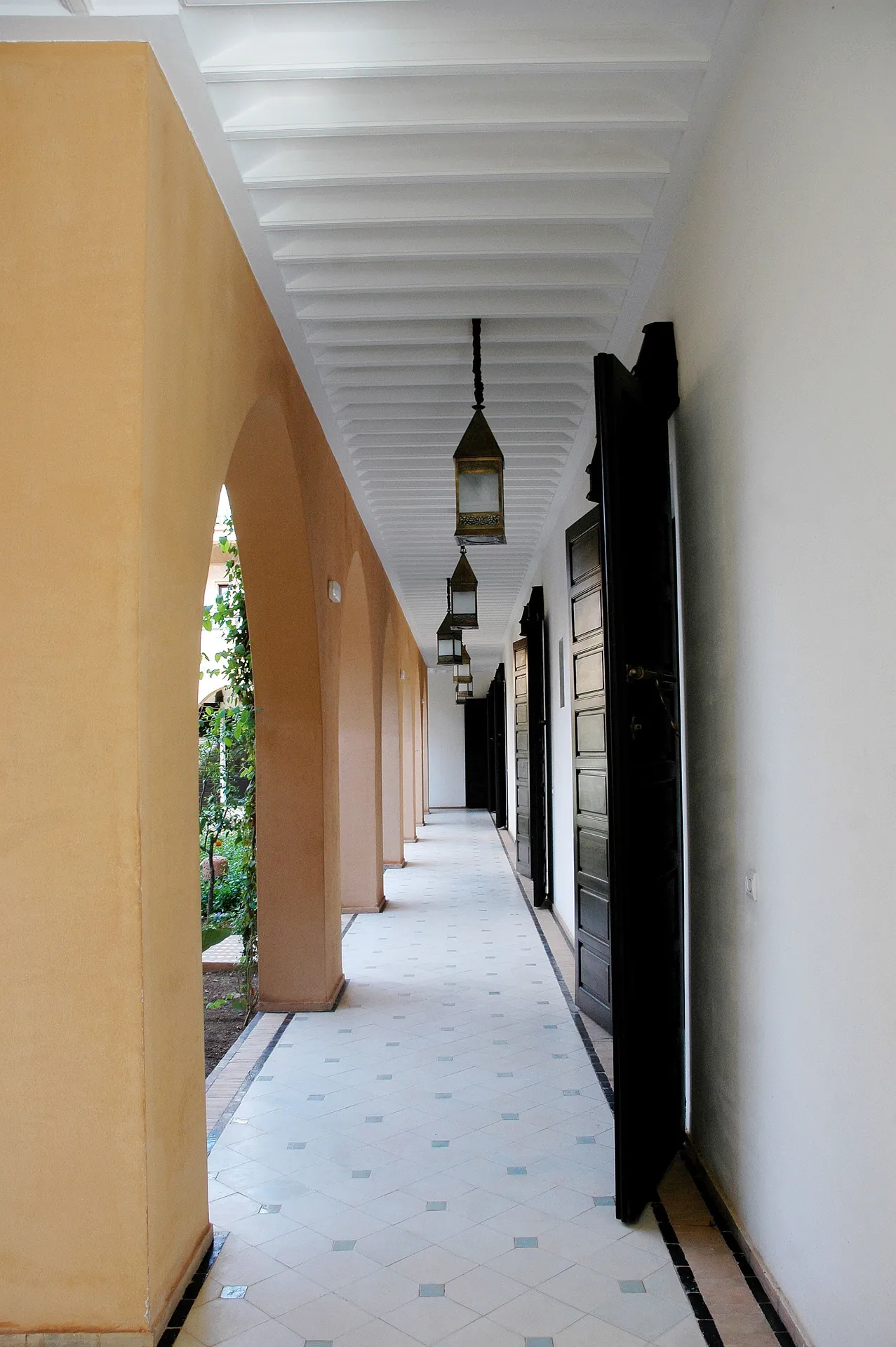
Renovation company in Marrakech: transforming existing buildings with method

Renovating a building in Marrakech is not simply about replacing finishes, repainting walls or modernising a few fittings. A successful renovation starts with understanding the existing building: its structure, layout, materials, technical services, architectural qualities and the constraints that may affect the works.
For a riad in the medina, a villa, an apartment, an office, a shop or a hospitality project, the real challenge is to strike a balance between what deserves to be kept, what needs to be improved and what must be completely rethought.
Choosing a renovation company in Marrakech able to coordinate design, works, interior architecture and site management allows the project to be treated as a coherent whole rather than a series of independent interventions.
BARJAL has developed this integrated approach in Marrakech by connecting architectural thinking, construction expertise, project coordination, sensitivity to Moroccan heritage and quality of execution.
Why a renovation in Marrakech requires a specific approach
Marrakech brings together very different architectural types.
An old riad does not call for the same decisions as a contemporary villa. A commercial space open to the public does not have the same uses as a private residence. Converting an existing building into a boutique hotel requires yet another approach.
Before defining the works, you need to understand the building and its future use.
Several issues can quickly become decisive:
- the real condition of walls, floors and ceilings;
- the existing structural configuration;
- any damp or deterioration;
- the condition of electrical and plumbing installations;
- ventilation and thermal comfort;
- circulation between spaces;
- natural light;
- compatibility between old and new materials;
- the functional needs of the owner or operator;
- coordination between design and execution.
A well-prepared renovation in Marrakech limits improvised decisions during the works and makes it easier to prioritise.
Start by understanding the existing building
The first mistake in a renovation project is often to think immediately about the final look.
Before colours, light fittings, furniture or finishes, you need to understand what the building really allows.
The initial analysis must identify the elements to keep, the areas to transform, the visible constraints and the points that need further investigation.
This step is particularly important when a project plans to change volumes, circulation, openings or the general layout of the building.
A renovation company in Marrakech must therefore be able to look at the project from several angles: architectural, structural, functional and aesthetic.
Define a brief before demolishing
A well-controlled renovation in Marrakech starts with a clear brief.
How will the building be used? How many people will live or work there? Which spaces are priorities? Which existing elements must be kept? What level of finish is expected?
In a villa, priorities may concern the relationship between living room, terrace and garden, bedroom privacy or the flow of reception spaces.
In a riad, thinking may focus on the courtyard, circulation, bedrooms, bathrooms, shared spaces and keeping certain traditional features.
In a shop or office, the user journey, visibility, ergonomics and operating constraints become essential.
Defining these needs before the works reduces late changes and gives all parties a shared direction.
Design-build applied to renovation
A renovation becomes complex when design and execution evolve separately.
An architectural decision can have a technical consequence. A change of material can alter certain execution details. A new interior layout can affect services or lighting.
The design-build approach aims to bring these decisions closer together.
Design, technical choices, materials, interior architecture and works are considered in a single process. This makes coordination easier and allows the feasibility of proposed solutions to be assessed earlier.
For an owner, an investor or a professional looking for a renovation company in Marrakech, this continuity is a major advantage: the project is designed to be built, and the site stays linked to the original intention.
The main stages of a renovation project
Understanding the goals
The project starts with the needs.
The future use, aesthetic expectations, planned level of transformation and the client’s priorities must be specified.
A project for a main residence will be organised differently from a riad intended for hospitality or a commercial unit.
Examining the building
The existing building must then be carefully observed.
The goal is to understand the spaces, materials, visible services, previous alterations and constraints likely to affect the works.
When there is a significant technical doubt, the appropriate checks must be carried out before making irreversible decisions.
Designing the transformation
Once the constraints are understood, design can translate needs into spaces.
This phase works on volumes, circulation, functions, light, materials and the overall atmosphere.
The design must remain compatible with the building’s structural reality.
Defining materials and details
Materials have an aesthetic role, but also a functional one.
In Marrakech, a project can combine elements inspired by Moroccan craftsmanship — wood, metal, stone, decorative plasters, zellige or other handcrafted expressions — with more contemporary lines.
The challenge is not to pile up decorative references, but to build a coherent language.
Planning the works
The site must be organised in a logical order.
Demolition, necessary repairs, services, partitions, ceilings, finishes, joinery, equipment and final details must be coordinated so that trades do not get in each other’s way and finished work does not have to be redone.
Supervising execution
The quality of a renovation depends heavily on supervision.
Decisions made on paper must be correctly translated on site. Interfaces between work packages must be anticipated, details checked and any adaptations handled without losing the overall coherence of the project.
Riad renovation in Marrakech: preserving without freezing
The riad has a particularly strong architectural identity.
The central courtyard, proportions, light, materials, circulation, terraces and craft details all shape its character. A transformation that is too brutal can erase what makes the place unique.
Conversely, preserving every element without thinking about new uses can limit comfort and functionality.
Renovating a riad in Marrakech therefore often means finding a balance.
It may make sense to keep certain materials, proportions or decorative elements while improving the layout, equipment, bathrooms, lighting, ventilation or the overall experience of the spaces.
This approach is particularly important when a riad is to become a residence, a guest house or a hospitality project.
Villa renovation in Marrakech
An existing villa can offer strong potential for transformation.
Works can involve interior architecture, façades, reception spaces, bedrooms, kitchens, bathrooms, terraces or the relationship with the garden.
But the success of a villa renovation depends above all on the coherence between these elements.
Visually enlarging a room without thinking about circulation, multiplying materials without a guiding line or treating the interior without considering outdoor spaces rarely produces a lastingly convincing result.
An overall approach, on the contrary, works on the villa as a single composition.
Interior architecture and renovation
Interior architecture should not be treated as a decorative layer added at the end of the works.
It shapes how spaces work.
Proportions, circulation, fixed furniture, lighting, storage, materials, textures and technical details directly influence the quality of the place.
In a renovation, this thinking must start early enough to be coordinated with the works.
A kitchen, for example, involves services, equipment, lighting, ventilation, furniture and finishes. Deciding on them separately increases the risk of incompatibilities.
BARJAL integrates this relationship between interior architecture and execution to maintain continuity between concept and site.
Renovating shops, offices and professional spaces
A commercial project has different constraints from a residential one.
The space must support a business.
In a restaurant, a shop, an office, a showroom or a hospitality space, the renovation must therefore consider the visitor experience as well as operational needs.
Circulation, reception, service areas, lighting, storage, acoustics, visibility, maintenance and durable finishes can play an important role.
For an operator, the project must be beautiful but also logical to use.
Design and construction then benefit from moving forward together.
Hospitality: creating a coherent experience
Marrakech has a particularly strong identity in hospitality projects.
Riads, guest houses and boutique hotels often need to combine local character, contemporary comfort and a memorable experience.
The renovation must then go beyond simple decoration.
The arrival, shared spaces, rooms, bathrooms, courtyards, terraces, lighting, materials and details must all tell the same story.
Moroccan craftsmanship can play an important part, provided it is integrated with precision rather than treated as added decor.
Restoration and buildings of character
Renovating and restoring do not mean exactly the same thing.
Renovation mainly aims to adapt and improve a building. Restoration places more importance on preserving its architectural character and significant features.
In an old building in Marrakech, every intervention therefore deserves careful assessment.
An existing element should not automatically be removed because it looks old. You first need to understand its value, condition and relationship with the project.
When conservation and transformation are properly balanced, the building can meet new uses without losing its identity.
Why site management is decisive
Many renovation difficulties do not come from a bad architectural idea, but from a lack of coordination.
An electrician works before certain furniture choices are finalised. A service opening is not planned for a piece of equipment. A finish has to be redone after another trade passes through. A detail defined on paper is not understood the same way on site.
These problems create delays, rework and avoidable costs.
Construction management structures execution, tracks progress, coordinates contractors and maintains the project’s key decisions.
For BARJAL, this coordination is an integral part of the design-build logic.
Common mistakes in a renovation in Marrakech
Starting works without a sufficient survey
The older the building or the more it has been altered in the past, the more the existing structure must be studied before major works.
Choosing on initial price alone
Two offers can cover very different scopes. You need to compare what is really included, the expected quality, the planned materials and the level of coordination proposed.
Constantly changing the project during construction
Some adjustments are normal in renovation. But constant changes slow execution and make the budget harder to control.
Completely separating design and construction
A design that ignores the execution method can lead to late adaptations.
Neglecting details
Junctions, alignments, joints, material transitions, equipment placement and finishes strongly influence the final perception of quality.
Needlessly erasing the building’s identity
In a riad or a building of character, replacing everything is not always the best answer. Some existing elements can become the highlights of the new project.
How to choose a renovation company in Marrakech
Before entrusting a project, it is useful to assess the renovation company’s working method as much as its portfolio.
Ask concrete questions:
- How is the project studied before work starts?
- Who coordinates the different phases?
- How are changes managed?
- How do design and site communicate?
- How are material choices integrated?
- What level of supervision is planned during execution?
- How are architectural details translated on site?
- Does the company understand the specifics of a riad, a villa or a commercial project?
A relationship of trust relies on clarity of scope, responsibilities, decisions and communication.
An integrated approach with BARJAL
BARJAL supports construction and renovation projects in Marrakech with an integrated vision.
The goal is to maintain continuity between the client’s intentions, the design of the spaces, the building’s constraints, material choices and execution.
Depending on the project’s needs, this approach can combine renovation, design-build, construction management, interior architecture and work on buildings of character.
It is aimed at private owners as well as investors, entrepreneurs and developers of residential, commercial or hospitality projects.
Preparing a renovation consultation
Before contacting a company, a few pieces of information make the first conversations considerably easier.
You can prepare:
- the location of the property;
- its type and current use;
- its future use;
- existing plans when available;
- photos of the building;
- the areas you want to transform;
- your functional priorities;
- your aesthetic references;
- the planned level of transformation;
- specific constraints already identified.
The more clearly the need is expressed, the more relevant the first thinking can be.
Frequently asked questions about renovation in Marrakech
Why choose a renovation company in Marrakech rather than several separate craftsmen?
A project involving several trades requires constant coordination. A renovation company in Marrakech able to manage the whole project can make communication easier, organise work sequences and keep design and execution more consistent.
What is the difference between renovation and design-build?
Renovation describes the transformation of an existing building. Design-build is a method that brings design and delivery closer together. The two can therefore be combined in the same project.
Can a riad be modernised without losing its character?
Yes, provided you identify what truly contributes to the building’s identity. Renovation can improve comfort and uses while keeping significant proportions, materials, details or architectural features.
Does BARJAL work on villas?
BARJAL positions its approach around residential, commercial, hospitality, renovation, construction and interior architecture projects in Marrakech. A consultation helps define the precise scope suited to the project.
Why integrate interior architecture from the start?
Because many interior decisions have consequences for the works: lighting, services, sockets, ventilation, joinery, built-in furniture, finishes and equipment. Anticipating them reduces incompatibilities.
How can you limit unpleasant surprises during a renovation?
It is impossible to know every hidden condition of an existing building in advance. Careful analysis of the existing building, a clear scope, a sufficiently developed design and regular supervision nevertheless help anticipate risks better.
Should everything be replaced during a renovation?
No. A relevant renovation starts by distinguishing the elements to preserve, repair, adapt and replace. This selection can also strengthen the character of the project.
Can a renovation company in Marrakech manage a commercial project?
Yes, provided its organisation and expertise suit the type of project. A shop, an office or a hospitality space must be designed around its daily use and operational constraints.
Making renovation a true architectural project
Transforming an existing building has a particular richness: the project never starts from a blank page.
You need to observe, understand, select, keep, correct and transform.
This is precisely what makes renovation demanding.
Choosing a renovation company in Marrakech with an integrated approach helps better connect architecture, construction, materials, site management and the quality of details.
BARJAL supports this process with a vision suited to the Marrakech context, where Moroccan craftsmanship, existing architecture and contemporary expectations can come together in a coherent project.
To study the renovation of a riad, a villa, an apartment, an office, a shop or a hospitality space in Marrakech, you can present your project to BARJAL on barjal.com to discuss your needs and the next steps.

